|
Identification
|
| Rare
Birds in Spain
Identification
Circumstances
of sighting
On 3rd January 2001 a local birder from El Prat de Llobregat saw a distant wheatear which he temptatively identified as Black-eared (O.hispanica). Soon, different friends from the local group CISEN, suggested the Desert Wheatear option, but as no other sightings occurred, the bird was quickly forgotten and the record was not spread.
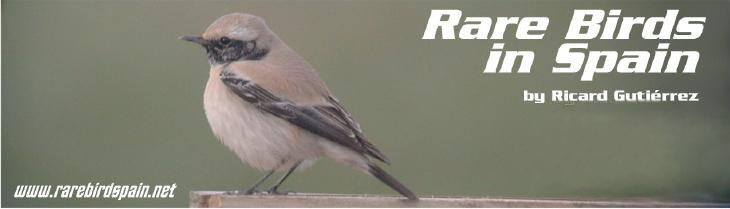
On 13th January, the Winter wildfowl and bird count was being carried out in the Delta. 19 different observers were scanning all the area and interesting species such as Ferruginous Duck Aythya nyroca or Little Bittern Ixobrychus minutus had been seen. While circulating within the boundaries of the Barcelona's Airport, Francesc Xavier Santaeufemia, Pau Esteban and Enric de Roa found a Wheatear which was identified at close range as a Desert O.deserti. The news were spread amongst all the team, but given security airport reasons, only a handful of birders could see it. On 17.1, and given the location of the bird, well in the airport main runway, in an area where falconry operations are held and also with heavy disturbance from neighbour works, it was agreed with Airport authorities to attempt trapping the bird and moving it into the nearby Remolar -Filipines reserve (distant c. 500 meters). We trapped the bird in an operation which we funnily called "deserti storm", ringed it and took a description and some shots. A typical
Oenanthe-like
passerine, with whole dark bill, dark feet and dark eye as well. Head with
creamy crown but with richer tones in a small area of the forehead. Supercilium
off white, it extends from above eye well into the ear-coverts area. Large
well defined black mask which covered face and throat having small buff
spots.
Lower parts more sandy-buffish towards breast and being paler towards belly and undertail coverts. Upper-tail coverts sandy or creamy, covering the white part of the tail and thus creating the effect of a whole black tail.
Wing with primaries, secondaries and tertials abraded and worn. Primaries and secondaries dark brown with a white area in their inner webs, well visible in flight. All primary coverts old, unmoulted. Three outer greater coverts brown edged white, old and worn, the three innermost new black and edged white. Alula old and worn. Black median coverts. Lesser coverts white near the body and black with small white edges in the forearm. Creamy scapulars. Underwing coverts jet black.
Tail with the central pair with slightly longer black area than the rest, not visible in the field due to the effect of uppertail coverts, worn and abraded, appear dark brown. The rest are less worn and appear more black. They form a broad solid band which perhaps covers more than half the tail length and all what is visible beyond uppertail coverts. Inner part of tail feathers pure white. Taken
by R.Gutiérrez and J.Bach
There are only three published and accepted records of the species in Spain: Barcelona's
Airport. There are only three previous accepted records in Spain
We include more photos of the bird in the photo page. Or see an abstract in French of this observation plus identification topics on this species at ornithomedia.com French web site: Ricard Gutiérrez 17.1.2001
Thanks to all the colleagues at CISEN for helping us with this record. Also thanks to AENA Environmental authorities for allowing us entering within BCN airport for censusing. Gracias a todos los compañeros del CISEN por ayudarnos con esta cita. También gracias al Depto. de Medio Ambiente de AENA en BCN por facilitarnos el censo del interior del aeropuerto. Gràcies als companys del CISEN per ajudar-nos amb aquesta cita. També gràcies al Dept. de Medi Ambient d'AENA a BCN per facilitar-nos els permissos per poder censar l'Aeroport del Prat. |
|
|
Recent reports | Rarities Committee Reports | Statistics | Photos | Files | Identification | Links | Homepage
Designed to be seen in 800x600
resolution with Java enabled browsers.
|
|
|
|